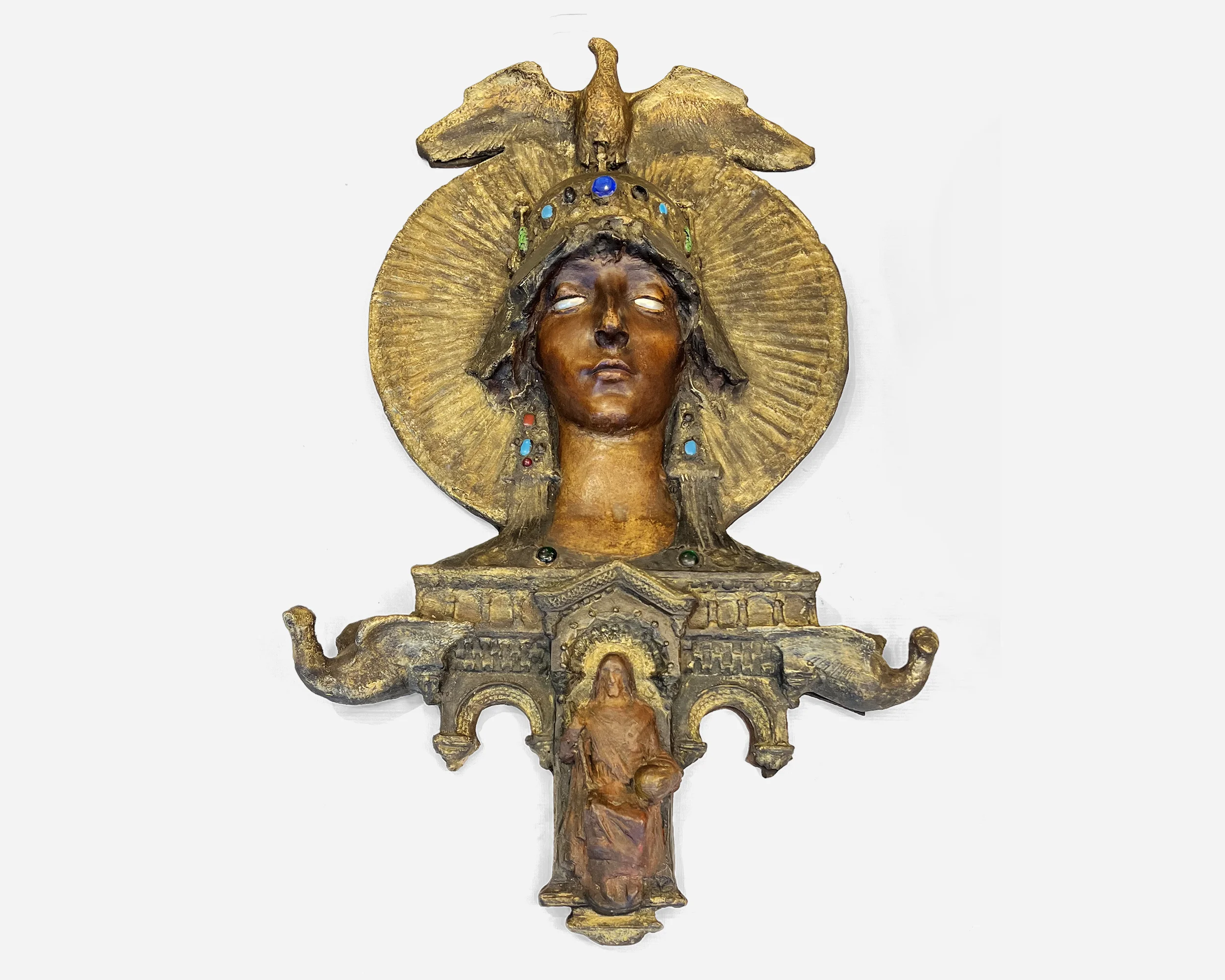
“Theodora, Florentine medallion,” polychrome and gilded plaster cast, by Jean Rivière
Toulouse, France, 1891
Biography
Jean Rivière (1853-1922) was a French sculptor and painter.
Born into a family of furniture makers, Jean Rivière spent his childhood in Saint-Paul-Cap-de-Joux (Tarn). In 1868, he left for Toulouse to study sculpture at the École des Beaux-Arts.
There he befriended artists of his generation, including Antoine Bourdelle, Jacques Labatut, Henri Marre, Paul Pujol, and above all the painter Henri Martin, his loyal friend for whom he made frames from precious woods. In 1890, Jean Rivière became a professor of ornamental sculpture at the Toulouse School of Fine Arts, where he held the chair from 1892 to 1922.
He was a multi-talented artist, working in terracotta, ceramics, goldsmithing, and cabinetmaking. His art was at the crossroads of Art Nouveau, Post-Impressionism, and Symbolism.
His major work, Théodora, created in 1891, was recently acquired by the Musée des Augustins in Toulouse.
Jean Rivière gained a certain degree of fame through his sculpture. He exhibited at the Salon des Artistes Français from 1882 to 1896, where he received honorable mentions in 1882 and 1887, and more regularly at the Salon de l’Union Artistique de Toulouse from 1885 to 1922. He became a member of the Artistes Français in 1893.
He was also part of the group of artists who exhibited in March 1899 in the studio of the painter Henry Gérard in Toulouse. He produced numerous religious works that adorned churches in his region. He also earned his living by carrying out commissions for public and private funerary monuments, and in Toulouse he received numerous official commissions, mainly to decorate the Salle des Illustres in the Capitole and the Musée des Augustins (completed in 1901).
You can find further information at this Wikipedia link, in French.